Interface II: Arteriolar function and the Vascular Waterfall
Reframing the Macro–Microcirculatory Transition
Why Perfusion Pressure ≠ (MAP – CVP)
Systemic blood flow is often considered to be proportional to the gradient between mean arterial pressure (MAP) and central venous pressure (CVP). This view implicitly treats the vascular system as a continuous, rigid hydraulic conduit as shown below. However, the real cardiovascular system is neither continuous nor rigid, and the transition from the macrocirculation to the microcirculation involves a involves a phenomenon often referred to as a vascular waterfall. This occurs at the level of the arterioles, which serve as the primary determinants of hydraulic energy loss and are the central regulators of regional perfusion. They represent a designed physiological choke point, where the circulatory system transitions from high-pressure pulsatile flow to low-pressure, steady flow.

Sylvester J et al. Clin Chest Med. 1983 May;4(2):111-26
The Vascular Waterfall in Systemic Circulation
Critical Closing Pressure and the Vascular Waterfall
A helpful way to understand critical closing pressure (CrCP) is through the analogy of a waterfall in a river.
Imagine a river flowing down a mountain. The river begins at an elevation of 1000 feet and halfway down it flows over a waterfall before continuing downstream. In this situation, the rate of water flowing over the waterfall is determined primarily by conditions upstream of the waterfall—such as the height of the river above it and any resistance to flow before the drop.
If one attempted to increase the flow rate by manipulating conditions below the waterfall—for example by lowering the riverbed further downstream—it would have little effect. Once water passes the lip of the waterfall, downstream conditions no longer determine the rate at which water goes over the edge. The controlling factors lie upstream of the fall.
A similar principle applies to blood flow in collapsible vascular beds, particularly in the microcirculation. This phenomenon is referred to as the vascular waterfall, and the physiological equivalent of the waterfall lip is the critical closing pressure (CrCP).
Definition of Critical Closing Pressure
Blood vessels—especially small arteries and arterioles—are not rigid tubes. Their patency depends on the transmural pressure, defined as:
where:
is the pressure within the vessel
is the pressure surrounding the vessel (tissue pressure, alveolar pressure, intracranial pressure, etc.)
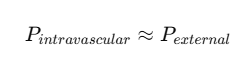
When the transmural pressure falls below a critical threshold determined by vascular smooth muscle tone and surrounding tissue pressure, the vessel collapses. The intravascular pressure at which this collapse occurs is called the critical closing pressure (CrCP). Importantly, CrCP is usually not zero. It is typically several mmHg above venous pressure, reflecting active vascular tone and external compressive forces.
Flow in the Presence of a Vascular Waterfall
As blood flows along a vessel, intravascular pressure gradually declines due to resistance. Under ordinary circumstances, flow through a rigid tube follows Ohm’s law:
However, when a vascular waterfall exists, the effective downstream pressure becomes CrCP rather than the measured venous pressure. Thus, flow is better described as:
Let's explore this in a bit more detail.
Dynamic Vessel Behavior
The behavior of a vessel approaching its critical closing pressure is best understood by considering the vessel as a collapsible tube, similar to a Starling resistor.
State 1: Fully Open Vessel
When intravascular pressure exceeds external pressure by a comfortable margin:
the vessel remains fully patent with a circular lumen. Under these conditions, flow behaves as it would in a rigid tube:
State 2: Formation of a Flow-Limiting Segment
As blood travels along the vessel, intravascular pressure continues to fall. At some point along the vessel, the intravascular pressure may approach the surrounding external pressure.
When:
the vessel begins to collapse. At this point, the lumen becomes elliptical or slit-like, increasing resistance and creating a flow-limiting segment within the vessel. This location effectively becomes the vascular waterfall.
At this point, the effective downstream pressure becomes CrCP rather than venous pressure. Flow is now determined primarily by the gradient between upstream arterial pressure and CrCP:
As long as downstream pressure (ie: CVP) remains below CrCP, changes in venous pressure do not affect flow.
State 3: Dynamic Collapse and Reopening
If intravascular pressure falls further and drops below the critical closing pressure, the vessel may narrow further and transiently collapse.
However, flow rarely ceases completely. Instead, a dynamic process occurs:
-
Blood continues to accumulate upstream of the collapsed segment.
-
Upstream pressure increases.
-
The rising intravascular pressure restores transmural pressure above the collapse threshold.
-
The vessel reopens and flow resumes.
The result is a dynamic equilibrium in which a partially collapsed segment regulates flow. Rather than acting as a rigid pipe, the vessel behaves as a self-adjusting resistor (a Starling resistor) that limits flow according to upstream pressure relative to CrCP. The pressure downstream of the partially collapsed segment (ie: CVP), so long as it is lower than the CrCP has no effect on flow. This dynamic behavior is analogous to water flowing over a waterfall: the rate of flow is governed by the height of water above the waterfall, not by conditions downstream.
Implications for Circulatory Physiology
As alluded to in above, the presence of a vascular waterfall means that in many vascular beds, downstream venous pressure does not determine flow unless it rises above the critical closing pressure.
Thus, flow is often more accurately described as:
rather than the traditional formulation:
This concept has important physiologic and clinical implications: CrCP is modulated by vasomotor tone, sympathetic activity, and external compression. For example, external compressive forces may increase the external pressure, thus raising CrCP. Consider the following:
-
alveolar pressure in the pulmonary circulation
-
intracranial pressure in the cerebral circulation
-
elevated interstitial pressure in edematous tissues
In these settings, the perfusion pressure gradient between the upstream pressure (MAP) and CrCP depends not simply on arterial and venous pressures, but on the relationship between arterial pressure, critical closing pressure, and vascular resistance.



Castro et al.Intensive Care Medicine Experimental (2025) 13:119
Why These Concepts Matter Clinically
In the graphic below, note that the pressure gradient between artery (square dot furthest to right) and vein (square dot furthest to left) is ~75mmHg. If we fail to account for critical closing pressure in the arterioles, one might assume that the tissue perfusing pressure (MAP-CVP) is ~75mmHg. But, because the CrCP is ~35mmHg, the actual tissue perfusing pressure is much smaller, ~45mmHg.
The clinical relevance of understanding the role of CrCP is substantial for the following reasons:
-
MAP is an imperfect surrogate for perfusion.
In vasodilatory states CrCP may be lowered and the effective tissue perfusion gradient may increase despite relatively low MAPs. In contrast, excessive vasoconstriction may increase CrCP and potentially reduce tissue perfusion pressure despite a higher MAP.
-
Vasopressors can help or harm depending on how they affect CrCP.
If a drug increases MAP and CrCP proportionally, tissue perfusion pressure will not be affected. However, if CrCP rises more than MAP, tissue perfusion pressure will worsen.
-
Regional perfusion may fail even with an apparently “adequate” MAP.
This explains why normalization of MAP does not always resolve shock at the microcirculatory level. This is likely why there is conflicting data regarding fixed MAP goals for treating patients with shock.
-
Bedside hemodynamic strategies could be transformed by monitoring TPP rather than MAP.
This would allow clinicians to titrate drugs based on true driving pressure into tissues rather than a crude macrocirculatory number.
Understanding the theoretical hydraulic break between macro- and microcirculation, the roles of CrCP, and the limitations of MAP-centric thinking is fundamental to interpreting shock physiology for correctly optimizing resuscitation strategies.
%202_27_26%E2%80%AFp_m_.png)
Pinsky MR, García MIM, Dubin .Crit Care. 2024 Apr 18;28(1):127.

